
Searching the Stearns County Court Docket
Start any Stearns County court docket search with Minnesota Court Records Online, usually called MCRO. The state courts run it. You can search statewide or narrow the results to Stearns. A case number is the sharpest tool. If you lack one, a party name, citation number, or attorney name will often do. Matches lead to Case Details. There the Register of Actions lays out the case activity in date order. When the matter belongs in Stearns County District Court, set the county filter. A blank result settles nothing, though. The filing may be restricted or pending. It may not be entered yet, or open only at a courthouse terminal. Keep the case number, citation, court notice, and key dates together before asking Court Administration to check a record.
- Open MCRO and accept its terms of use before choosing a search tab.
- Select Name, Case Number, Citation Number, or Attorney based on the information available.
- For a name search, choose the person or business option and add the Stearns County location filter.
- Open Case Details and read the Register of Actions in sequence, including later hearing and disposition entries.
- Use the calendar, MNPAC terminal, or Court Administration when the online view does not answer the record question.
Note: MCRO is a public lookup tool, nothing more. It does not issue certified copies, and an empty result there does not prove a case has no further activity.
Stearns County MCRO Search Paths
MCRO splits its work into four tools. They can blur together at first. Case Search finds a case and its Register of Actions. Document Search pulls public documents once you hold a case number. Hearing Search tracks scheduled events. Judgment Search covers docketed money judgments and their current status. Picking the wrong tab is easy. It can make a hearing list or a judgment line look like the whole Stearns County court docket. The official MCRO overview spells out these separate search products and their remote-access limits. For a public case lookup the interface works well. Still, it cannot replace a counter inspection. That matters when a record is public but sits outside the remote categories.
| MCRO tool | Best use | Stearns County result |
|---|---|---|
| Case Search | Find a public case and its chronology | Case Details and Register of Actions |
| Document Search | Find eligible documents for a known number | Public remote documents, if available |
| Hearing Search | Check a scheduled event | Hearing details and a link to case information |
| Judgment Search | Check a docketed money judgment | Status, date, and satisfaction context |
The MCRO access page opens onto four tabs, and each tab does a different job. Because of that layout, one Stearns County docket search can turn into two or three passes through the search forms before the right case number turns up.
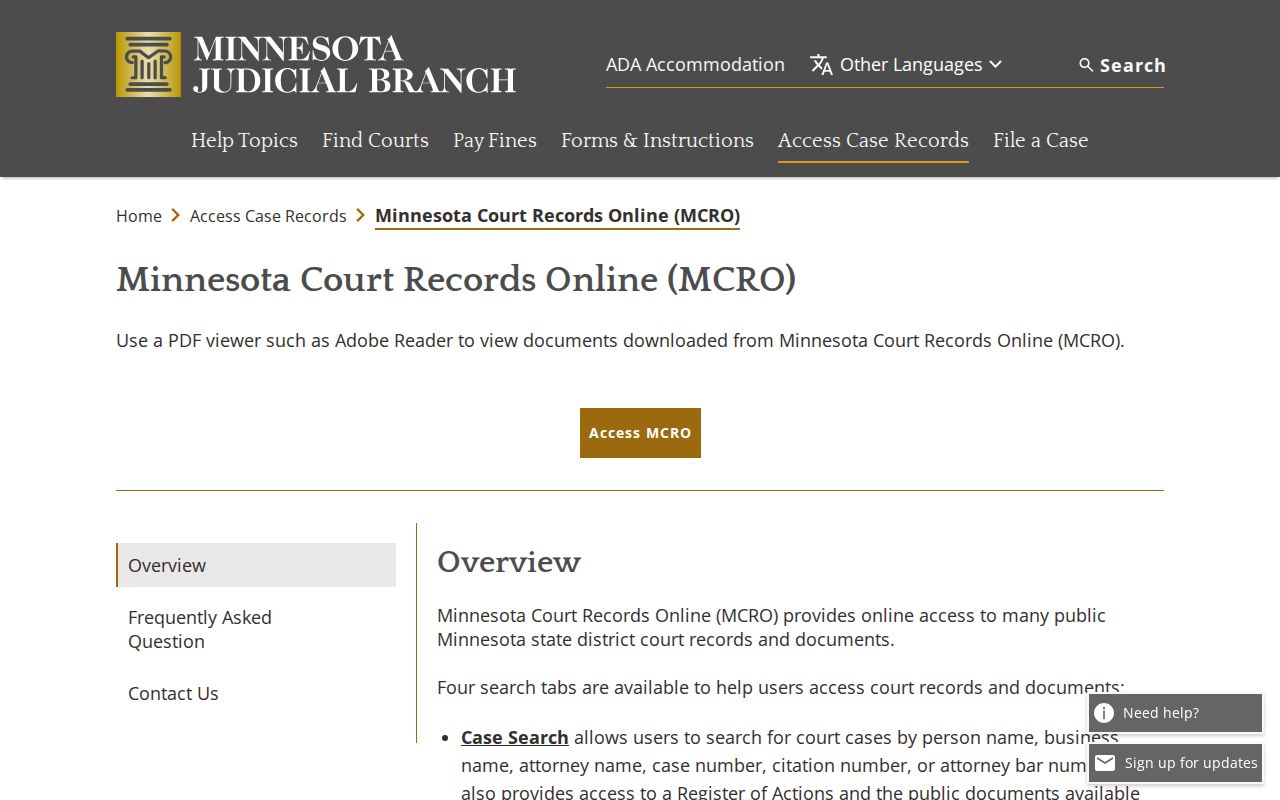
Match the tab to your question. Then verify any time-sensitive answer against the current calendar or a call to Court Administration.
Inside a Stearns County Court Docket
Minnesota names its chronological docket the Register of Actions. Every filing, activity, proceeding, and court event lands there in order. The case category itself is not a result. A hearing entry on a future date is only a setting. It does not prove the event happened. Nor does it prove the case was resolved. Read the dates in sequence. A later continuance, disposition, satisfaction, or appeal can change what an earlier line means. A public case display may show parties and roles. It can list attorneys, a charge or claim block, filing dates, court location, hearing details, event descriptions, and eligible document links. Exactly what appears depends on the case category and the access rules. Personal identifiers and protected details do not wipe out the other public portions of a court record.
| Case number | The state identifier used to retrieve the Stearns County case. |
|---|---|
| Filing date | When the case opened or an initiating filing was accepted, not necessarily when events occurred. |
| Case category | A system grouping such as criminal, civil, family, probate, or mental health. |
| Register entries | Chronological filings, hearings, orders, and other court activity. |
| Hearing details | Scheduled date, time, location, judicial officer, type, and displayed connection information. |
| Disposition or judgment | A resolution, order, amount, satisfaction, or status when the public record displays it. |
Stearns County Docket Codes
A Stearns County criminal calendar can carry numbers in the form 73-CR-26-####. After the local prefix comes a category code, a two-digit year, and a sequence. A civil case followed the same shape, 73-CV-26-####. The pattern is handy for spotting the court file. It says nothing about whose case it is. It also says nothing about how it ended, or whether the history is complete. Category cues you may see include CV for civil, FA for family, CO for conciliation, and PR for probate. Trust the case number over a city name. St. Cloud and Sartell both reach beyond Stearns County. If a notice or citation names a different county, use that court location. Do not assume Stearns County holds the record.
- Register of Actions
- The chronological list of court activity and filings for a case.
- Disposition
- The recorded resolution or outcome. Read its date and full entry.
- Satisfaction
- An entry showing that a judgment was paid, released, or otherwise satisfied.
- Continued
- A setting moved to another date. Look for the later event.
Note: A category code helps identify a file. It does not establish a charge, a result, or the current access level.
Courts That Keep Dockets in Stearns County
One court holds nearly every docket in Stearns County. Stearns County District Court is the general-jurisdiction trial court. It is part of the Seventh Judicial District, and it handles criminal, civil, family, probate, juvenile, and traffic cases. Its Conciliation Court division handles small claims; it is not a separate county court. Losing parties usually appeal. They go to the Minnesota Court of Appeals, a different level with its own records system.
City prosecutions work a bit differently. A city attorney can start ordinance and traffic cases. The adjudicated docket still runs through District Court and its violations process. No separate public city-court portal appears just because a city prosecutes. Federal matters live in PACER and federal CM/ECF, not MCRO, so a docket search there takes different tools.
| Court or division | Docket covers | Where to search |
|---|---|---|
| Stearns County District Court | Criminal, civil, family, probate, traffic, and related matters | MCRO, MNPAC, or Court Administration |
| Conciliation Court | Small claims within District Court | MCRO and Court Administration |
| Minnesota Court of Appeals | State appellate matters | Appellate court records, not the local trial docket |
| Federal courts | Federal civil, criminal, and bankruptcy matters | PACER or CM/ECF, not MCRO |
Stearns County Court Docket Buildings
Stearns County splits its court operations across two downtown St. Cloud buildings. Civil, family, juvenile, and jury matters sit at 725 Courthouse Square. Criminal, traffic, and fine-payment matters go to 815 Courthouse Square. Let the case category and your most current notice pick the building. That matters above all when a hearing has been reset. A courtroom reassignment is possible too. The Stearns court location page is the primary source for that split. Court Administration keeps the local records. It can sort out a record location, a copy request, or a calendar question. Call 320-656-3620 during posted weekday hours.
Stearns County Court Administration
725 and 815 Courthouse Square
St. Cloud, MN 56303
320-656-3620
Note: A St. Cloud address alone does not settle venue. Official city guidance points to nearby county-court routes as well.
How to Find Court Dates and Settings
A Stearns County court date can surface in several places. MCRO offers Hearing Search, Case Details, a live daily calendar PDF, and mailed court notices. Each one serves a different purpose. Hearing Search lets you filter by name, case number, judicial officer, attorney, category, date, and county. The daily calendar, by contrast, only lists scheduled hearings. It is not a complete Register of Actions. It also does not report how a hearing turned out. Check the freshest sources before you appear. The daily PDF lists party name, hearing location, date and time, judicial officer, hearing type, connection type, and case number. The Stearns County Court Dates page lays out the full check sequence. It also explains how settings can move. Keep one caution in mind. A scheduled hearing proves nothing about whether the event happened, continued as planned, or produced a final court result.
Stearns County Docket Calendar Limits
The official Stearns calendar instructions say the daily calendar posts around 7:00 a.m. on business days. It updates each hour. Judge assignments and courtrooms can still shift. For the freshest information, the court points to the printed calendars posted outside courtrooms and in public lobbies. Treat the live PDF as a tool for today, not an archive of every past setting.
Confidential matters and cases sealed off from remote access simply do not show. A missing entry proves nothing. It was not necessarily canceled or rescheduled. When the notice and the calendar disagree, trust the date on your notice and call Court Administration.
For deeper digging, the Stearns County records and research page gathers the court resources behind this calendar in one place.
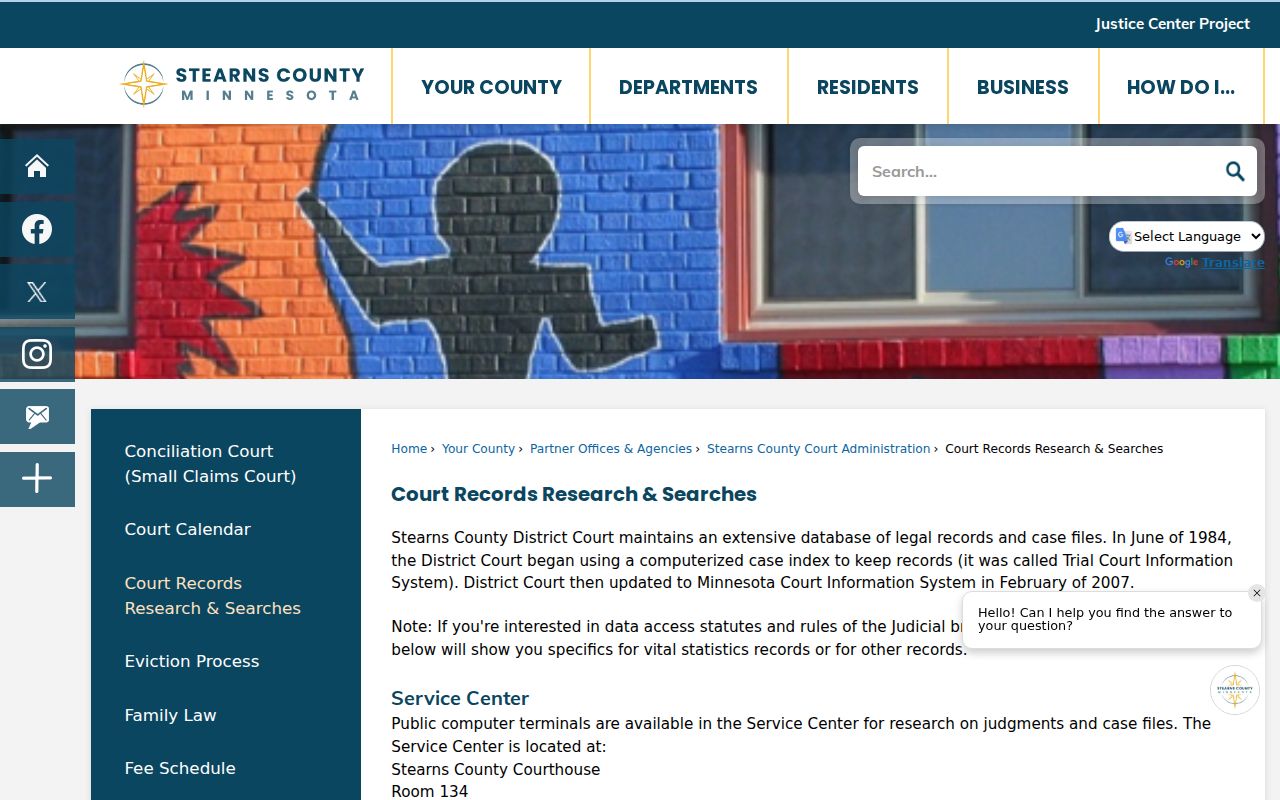
The county records hub points back to court resources. It still does not replace the current court calendar or a case notice for a Stearns County docket check.
Stearns County Docket Access Layers
Public access in Stearns County works in three practical layers. MCRO supplies selected public remote data and eligible documents. Minnesota Public Access, called MNPAC, adds more complete electronic access through courthouse terminals. Court Administration handles the local side. It covers inspection, plain copies, certified and exemplified copies, and questions about any public record that is not online. The official MNPAC information explains why remote and courthouse access differ. Under Rule 8, a public original record may be inspected or copied where the custodian normally keeps it. Regular hours apply. Confidentiality and retrieval limits still govern. That gap matters most for older files. Restricted remote categories and documents without a public online link feel it too. The MNPAC page shows the courthouse-terminal option. It rounds out a Stearns County court docket search.
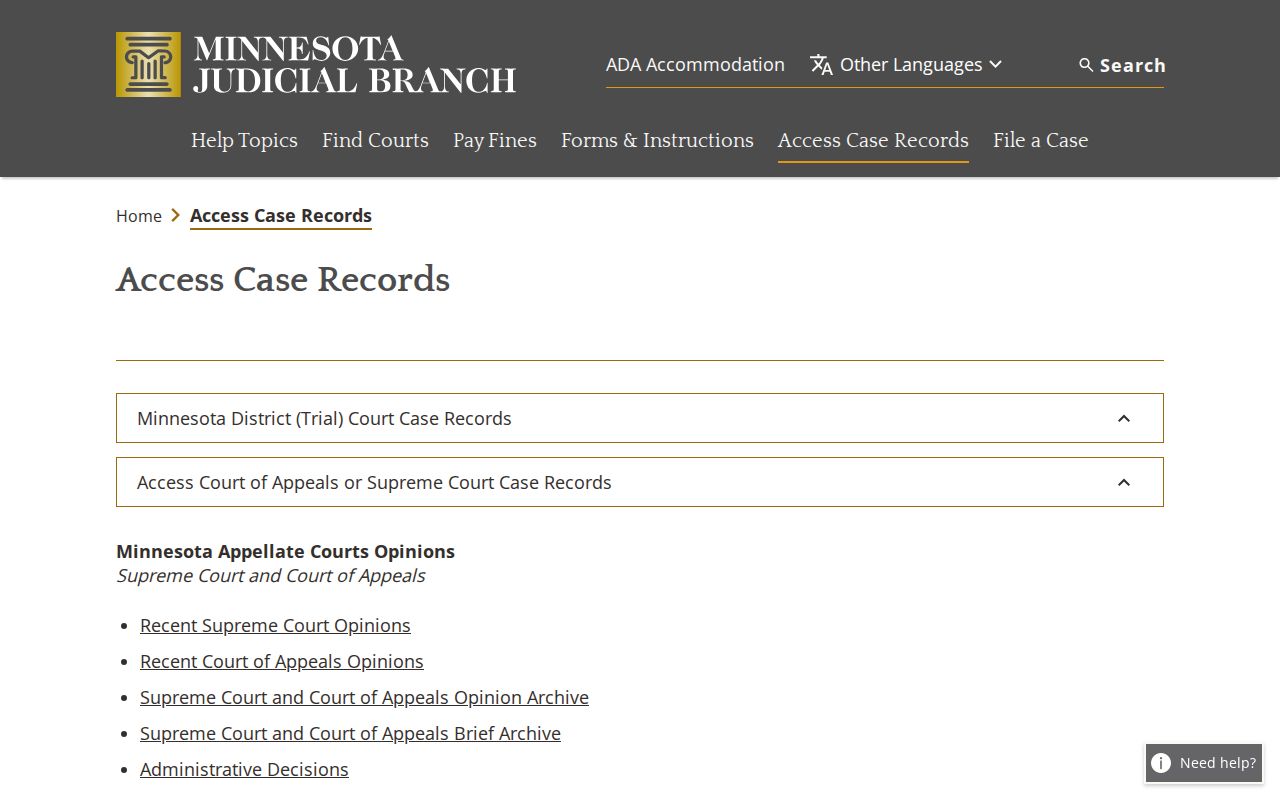
Terminal access still runs under court rules and local use procedures. For any record-location question, Court Administration remains the right contact.
Public Access to Court Dockets
Minnesota Statute §13.03 belongs to the state public-data framework, but Judicial Branch rules govern court case records more directly. Rule of Public Access 8 sets the baseline. It covers public inspection, remote registers, calendars, indexes, judgments, and eligible documents, while shielding identifiers, addresses, account data, protected people, and nonpublic case types. A remote limit is not a destroyed record. Pending criminal name searches, juvenile matters, sealed files, certain family materials, domestic-abuse records, exhibits, and other protected categories can each carry different access treatment. An empty search result tells you little. Ask Court Administration about the proper route.
Key Minnesota access rules:
Rule of Public Access 8 explains public inspection and the boundaries of remote court-record access.
General Rule of Practice 11 addresses restricted identifiers and the correction path for confidential filing treatment.
Rule 4 gives special treatment to domestic-abuse and other nonpublic court records.
Juvenile Protection Rule 8.04 protects confidential juvenile-protection information.
Minnesota Statute §609A.03 supplies the expungement and sealing framework.
Stearns County Drug Court Dockets
The 2022 Minnesota Judicial Branch annual-report material marks the twentieth anniversary of Stearns County Drug Court. That history creates no separate public records custodian. Nor does it open a special public search portal. When a specialty-court participant has a public criminal case, the record usually stays under the underlying District Court case number. Its ordinary Register of Actions still governs. Treatment plans, medical information, and protected participant details are not public docket content. The practical search stays the same. Try MCRO where the record is public. Then ask Court Administration about anything missing or restricted. The specialty-program label alone should never lead you to infer that a person has a public record or any particular case status. The anniversary recognition supports a history point only, not a claim that a separate current specialty-court docket is publicly searchable.
Docket Records at the Clerk’s Office
Stearns County skips the Texas model of a stand-alone district clerk. Court Administration serves as the working clerk for the District Court and its docket records. Guidance there covers civil, criminal, traffic, family, probate, juvenile, conciliation, and judgment files and their kin.
Need the document behind a docket entry? Start with MCRO when the file is available remotely. Plain copies are generally free. A certified copy runs $14 per document, and an exemplified copy carries its own charge. You can request records in person. Mail goes through the statewide process. eFile and eServe works in a known case when the filer rules allow it. The Stearns County court record search page compares all these channels side by side.
For a question about any of it, the Judicial Branch contact page points you to local Court Administration. That office answers for these records.
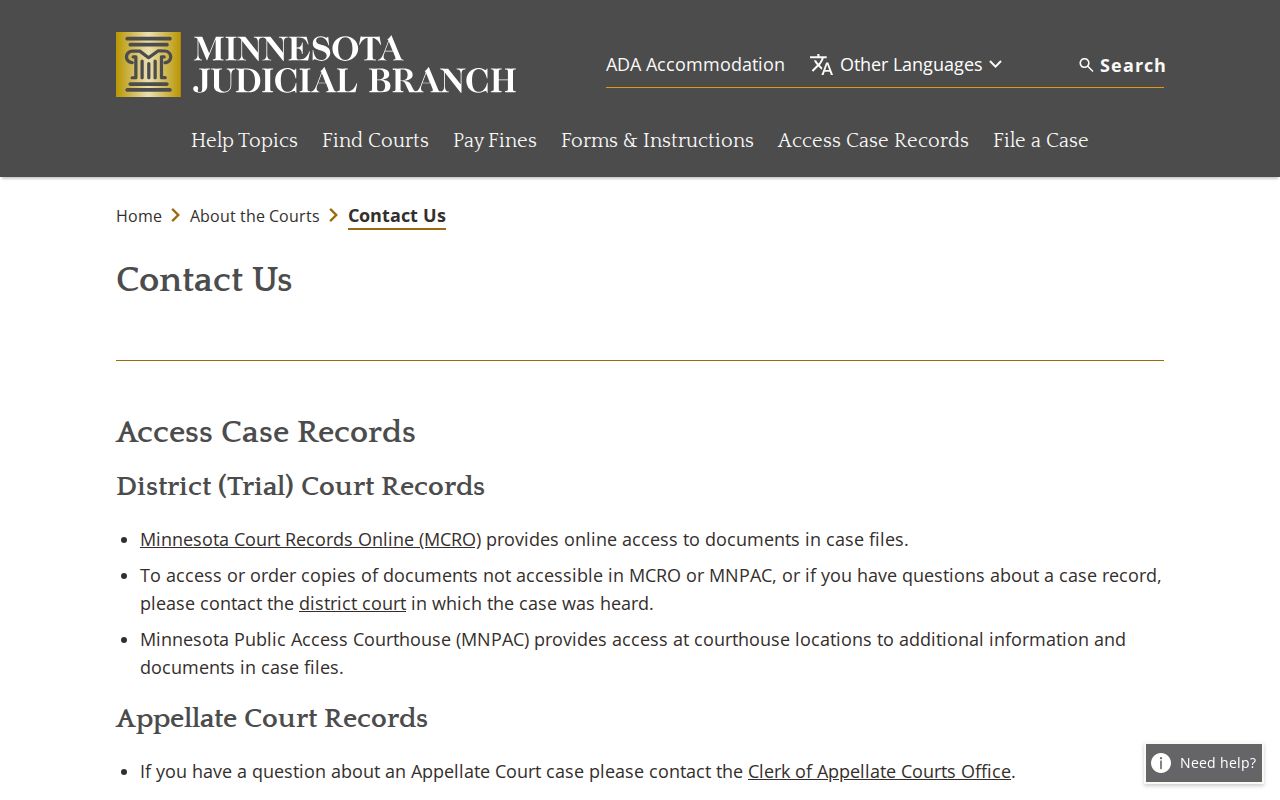
For urgent calendar or record-location questions, call the court directly. A general online contact form is the slower route.
Stearns County Courthouse History
Court history in Stearns County explains where its records live today. The first courthouse went up in 1864. A Beaux-Arts replacement followed in 1922. That building on the square now holds the county law library. Active court work runs through the District Court's two-facility model instead. Keep the roles straight. The law library serves legal research. Court Administration is the counter for official records and copies.
Older case files may not sit beside new electronic ones. A historic docket entry can live in a paper file, appear at MNPAC, or fall under a confidentiality rule. Court Administration will tell you which applies before you assume a document is downloadable. That quick local check saves a wasted trip. It also beats guessing about the court docket you need.
Note: The historic law library supports legal research. Court Administration remains the local route for an official record or copy request.
Stearns County Court Dockets by City
These five Stearns County cities rank highest in Minnesota's 2023 incorporated-city population. Not every one runs its own public municipal-court docket portal, though. City ordinance and traffic cases often travel elsewhere. They go through the Minnesota District Court and its violations process instead. Check the citation: the court named there tells you where the case lives. That clue matters most in St. Cloud and Sartell, two cities that cross county lines.
St. Cloud Docket Search
2023 population 71,321. Confirm the county named on a citation because St. Cloud can route to three county courthouses.
Sartell Docket Search
2023 population 19,673. Sartell spans Benton and Stearns, so choose the county printed on the case material.
Waite Park Docket Search
2023 population 8,354. City-prosecution context does not replace the District Court record route.
St. Joseph Docket Search
2023 population 6,969. General city payments are not a separate public court-payment portal.
Sauk Centre Docket Search
2023 population 4,588. Use the citation’s court and case details before starting an MCRO search.
Map and Directions to the Stearns County Courthouse Square Facilities
Stearns County District Court splits its records between two adjoining downtown St. Cloud buildings on Courthouse Square. Civil, family, juvenile, and jury matters are handled at 725 Courthouse Square, while criminal, traffic, and fine payments go to 815 Courthouse Square. The county law library sits at 725 Courthouse Square, Room 105, inside the historic 1922 building.
725 Courthouse Square
725 Courthouse Square
St. Cloud, MN 56303
320-656-3620
Monday through Friday, 8:00 a.m. to 4:30 p.m.
815 Courthouse Square
815 Courthouse Square
St. Cloud, MN 56303
320-656-3620
Monday through Friday, 8:00 a.m. to 4:30 p.m.
Confirm which of the two buildings a hearing or filing belongs in before arriving, since civil and criminal matters are split by address. Court Administration closes for court holidays, and the office reviewed did not document a specific parking, security-screening, or accessibility policy, so call ahead with those questions.