
Stearns County Court Calendars Explained
The official Stearns County calendar page puts out a daily calendar for Stearns County District Court. It sits in Minnesota's Seventh Judicial District. Think of it as a one-day view of courtroom events. It is not the full Register of Actions, the name Minnesota gives the running record of filings and case activity. A calendar row points to a setting. The case record holds the story.
Two downtown St. Cloud buildings host the court. Civil, family, juvenile, and jury work is assigned to 725 Courthouse Square. Criminal, traffic, and fine payment happen at 815 Courthouse Square. Treat that split as a first check, not a substitute for the location listed in current case information. An appeal goes to the Minnesota Court of Appeals. It does not show up as a new trial-calendar entry in Stearns County.
Stearns County Daily Calendar Updates
Expect the daily calendar around 7:00 a.m. on business days. Hourly updates follow after that. A new judicial officer or courtroom can shift the schedule without much warning. Printed calendars posted outside courtrooms and in public lobbies carry the most current daily information. The court itself says so. A same-day hearing is different. A printed posting may settle a mismatch between an older online view and the live calendar.
The official calendar instructions lay out the posting schedule and what the display leaves out.
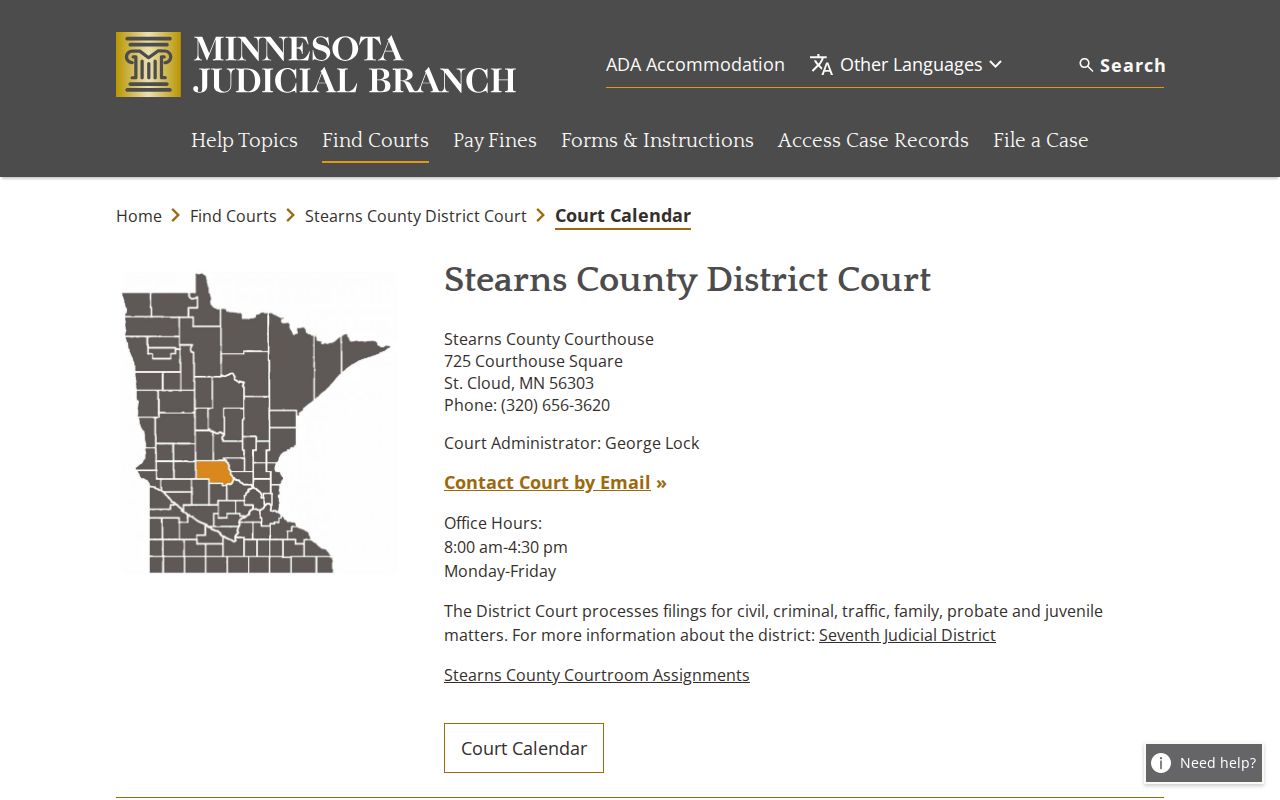
Because the calendar refreshes, always check the date on any view instead of trusting a saved copy. There is no public archive of past daily PDFs. The live daily PDF is a current snapshot only, and it cannot prove what an earlier hearing schedule said.
Finding Your Court Date
Start with a case number if you have one. It filters far better than a name. It also links a hearing result straight to its Case Details. No number? You can also search by name, hearing date, judicial officer, attorney, case category, and county. Then open the current daily PDF too. The court keeps it as a separate same-day calendar source.
- Open MCRO Hearing Search, accept its terms, and search by case number or a permitted name. Add a hearing date or range, category, and Stearns county selection when known.
- Read the current daily calendar PDF for the hearing date. Compare its location, time, judicial officer, and hearing type with the MCRO result.
- Check the courtroom assignments page for the current judicial-officer and courtroom allocation.
- Call Stearns County Court Administration at 320-656-3620 if the sources conflict, the setting is absent, or the building is unclear. The counter is also the local public-access route for questions that online tools cannot answer.
- Verify the building shown for the matter: 725 Courthouse Square handles civil, family, juvenile, and jury functions, while 815 Courthouse Square handles criminal, traffic, and fine-payment functions.
- When already at the courthouse, check the printed lobby or courtroom calendar because the court identifies it as the most current daily information.
MCRO is the public search system here. Minnesota Judicial Branch eFile and eServe handles filing, not public court-date lookup. For how you must appear, check the case itself. Rely on the notice or instructions inside the case.
Remember, a calendar date shows a scheduled event. It says nothing about whether the event happened or how the court ruled.
Stearns County Hearing Search and PDF
MCRO Hearing Search and the daily PDF answer two different questions. Hearing Search reaches scheduled hearings by name, case number, judicial officer, attorney, date, category, and county. The PDF covers one day at a time. Neither promises a full list of restricted matters. Neither replaces the notice in a case.
The official Hearing Search form gives you the controls for a Stearns County court date search.
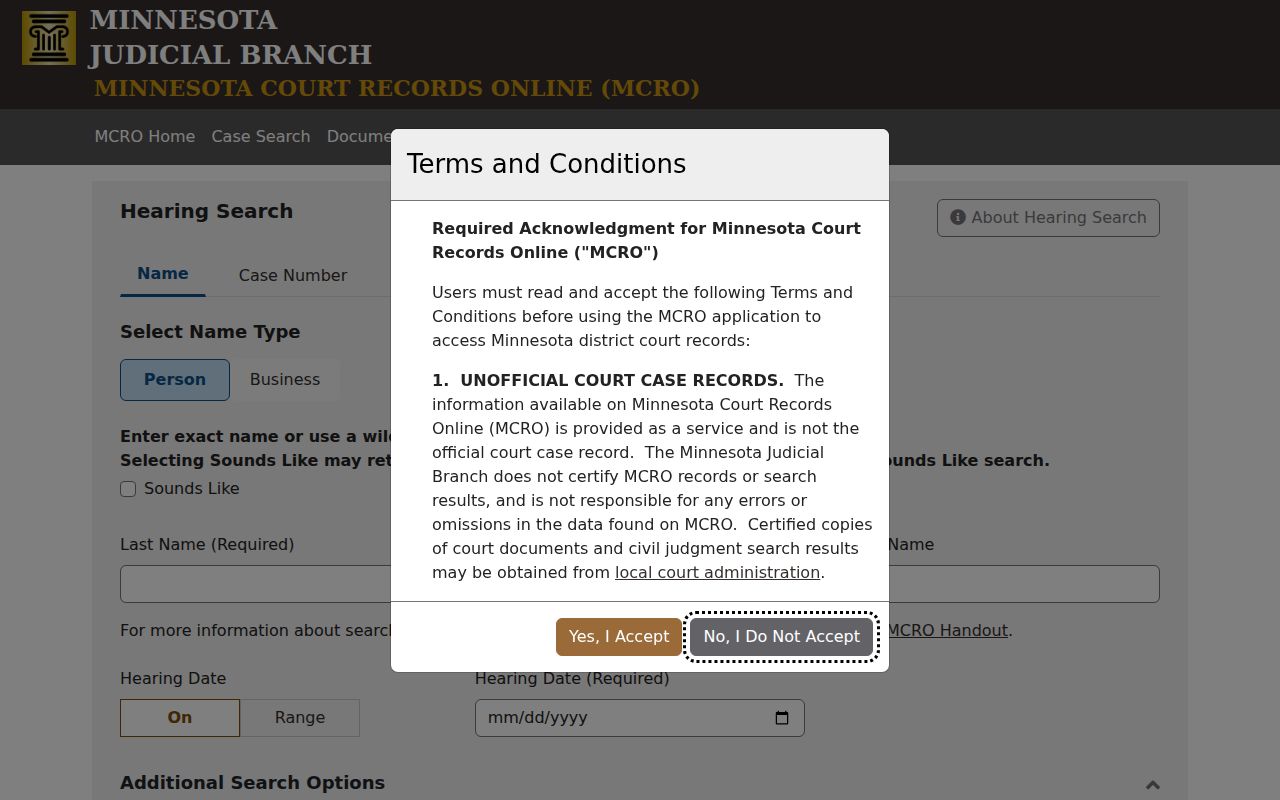
Adding a date filter and selecting Stearns county turns the tool into a focused way to find a public setting. It is ready for comparison against the daily PDF. One caution. A search result or calendar row is not an outcome. For later filings, a disposition, or a changed setting, read the Register of Actions. With a case number in hand, the related Stearns County case lookup supplies that chronology.
How to Read a Court Setting
Seven fields make up a row on the daily Stearns County calendar. Read them as a set. The time and hearing type tell you what event is scheduled. The location and judicial officer show where it is assigned. A party name or case number ties the line to a matter, though a listed line never proves the hearing actually took place.
| Party Name | The public-facing party label on the calendar. Some protected matters are omitted. |
|---|---|
| Hearing Location | The facility or courtroom text for the setting. Verify it against current assignments. |
| Hearing Date Time | The scheduled date and time, not a promise that the hearing will proceed unchanged. |
| Judicial Officer | The officer shown for the setting. Assignments can change during the day. |
| Hearing Type | The event label, such as arraignment, pre-trial, motion hearing, or conciliation hearing. |
| Connection Type | A displayed connection or participant label. It is not a remote-appearance instruction. |
| Case Number | The state case identifier that can be used in MCRO for the Register of Actions or documents. |
Handle Connection Type with care. You might see labels like Attorney or Petitioner. A label alone gives no video link and no approval to appear remotely. Follow the case notice, or ask Court Administration what instructions apply.
Stearns County Court Setting Terms
Calendar terms describe why a setting exists. Not every term means the case is ending. The official PDF mixes criminal labels with civil and family ones, so the case category and the Register of Actions supply the context you need. A court trial setting, for instance, is a scheduled bench-trial event, not a verdict.
- Initial Appearance or First Appearance
- An early criminal setting addressing rights and release matters under the Rule 8 label.
- Arraignment
- A formal charge and plea stage.
- Omnibus Hearing
- A criminal pretrial label that can involve evidentiary, probable-cause, or suppression issues.
- Motion Hearing
- A setting for argument or decision on a motion.
- Scheduling Conference
- A setting used for timing, discovery, hearings, or trial planning.
- Conciliation Hearing
- A setting in Conciliation Court, the District Court small-claims division.
The official calendar material also uses Review Hearing, Recommitment Hearing, Intermediate Disposition Hearing, and the generic label Hearing. For the precise nature of an event, check the current case details.
Continuances, Resets, and Cancellations
Schedules shift. A continuance moves a hearing to a new date. A reset does much the same, and a cancellation takes it off the calendar entirely. Any of these can leave an older notice or docket entry out of step with the real schedule. Stearns County refreshes its daily calendar hourly. A stale listing tells you a change is likely, not that the case is over.
Check Hearing Search and Case Details first. Then compare the current PDF against the courtroom assignments. If the calendar and a notice disagree, Court Administration can straighten out the official local record. A missing name is never proof of a cancellation on its own. Confidential and non-remotely accessible matters stay off the public calendar under the access rules. A courtroom or judicial-officer reassignment can also change a calendar row. So rely on the live sources on the hearing day itself.
Stearns County Courtroom Assignments
A docket search points you to a hearing. The next question is where to sit. The Stearns courtroom assignments page answers that for Stearns County, pairing each judicial officer with a morning or afternoon courtroom slot and any remote connection notation. The roster can shift as visiting and rotating officers come through. Expect to see the assistant chief judge, district judges, and court staff listed alongside their assignments.
For current judge, time, courtroom, or connection details on a Stearns County court docket, turn to the official assignment page. It shows all of it. Treat it as a snapshot of today's schedule, not a permanent case history.
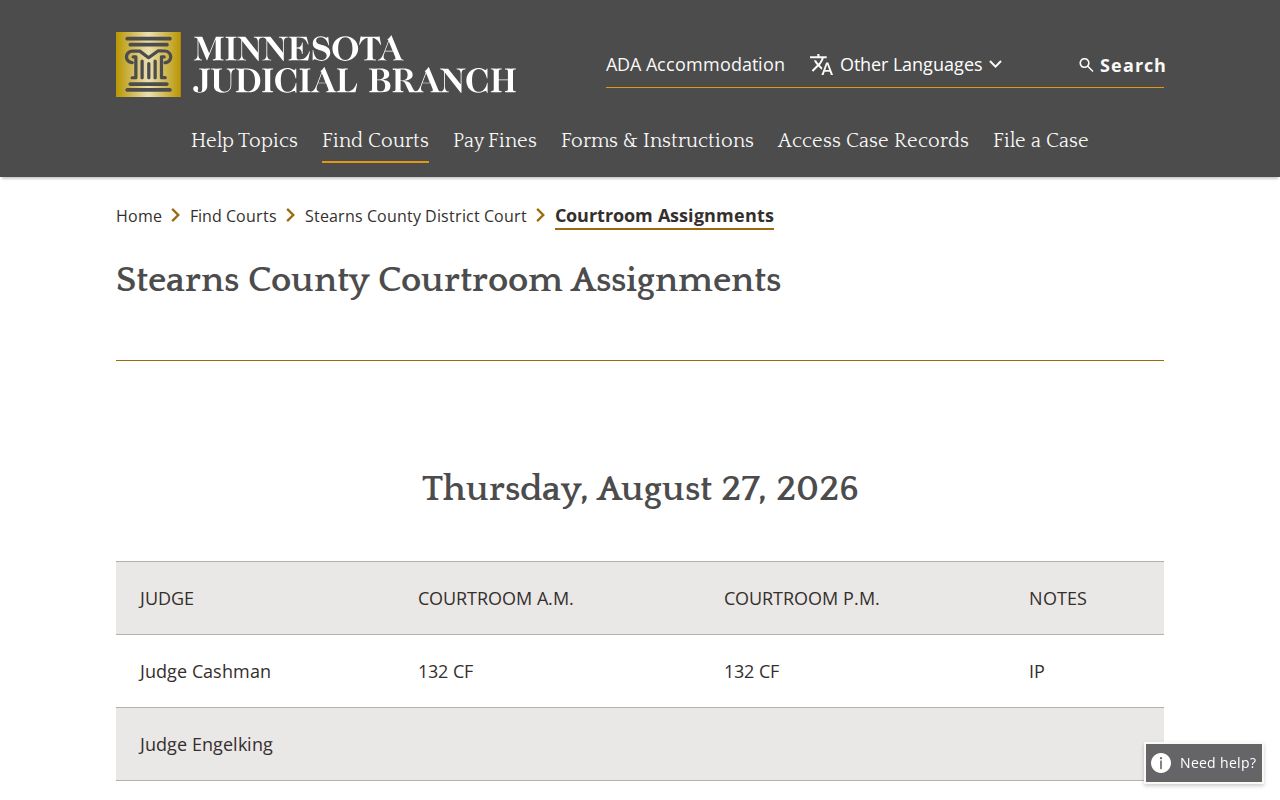
Lay the daily PDF beside that page. Then you can tell a single case setting apart from the court's broader courtroom allocation. Confirm the facility the record shows before you go. Civil, family, juvenile, and jury functions sit at 725 Courthouse Square. Criminal, traffic, and fine-payment functions use 815 Courthouse Square instead.
If You Miss a Court Setting
Missed a court date? Call Stearns County Court Administration right away at 320-656-3620. Give the case number if you have it. Ask where the public calendar now stands or what route the case should take. If counsel represents you, follow the instructions your lawyer gives as well. One caution. The calendar alone cannot tell you what an absence means for a particular matter.
Act promptly. A missed Stearns County court setting needs direct confirmation because a calendar entry cannot show every case event or current instruction.
Use the live daily calendar and MCRO for context, then contact Court Administration when the record or notice is unclear.
Restricted, confidential, or sealed matters often do not appear in public calendar or remote search results at all. Ask the local office about the public-access route. A missing online entry does not prove that no hearing exists.
Stearns County Calendar Access Limits
Minnesota Rule of Public Access 8 opens the door to remote viewing of certain calendars, registers, indexes, judgments, and eligible documents. It also shields protected information and nonpublic case types. That is why a Stearns County court calendar can never be read as a full inventory of every hearing. Confidential and non-remotely accessible cases may simply be omitted. That category reaches juvenile-protection records, domestic-abuse records, and other protected classes of court records.
When a public record fails to surface in MCRO or on the calendar, two documented channels remain. The courthouse MNPAC terminal is one. Stearns County Court Administration is the other, and each is governed by the rules. The Rule 8 text spells out the full scope of what the public may reach.